What Is an AI Solutions Architect and How to Hire One
Artificial Intelligence
What Is an AI Solutions Architect and How to Hire One
Sep 15, 2026
about 17 min read
To understand what is an AI solutions architect, start with the end-to-end system that makes useful AI work.
To understand what is an AI solutions architect, start with the end-to-end system that makes useful AI work.
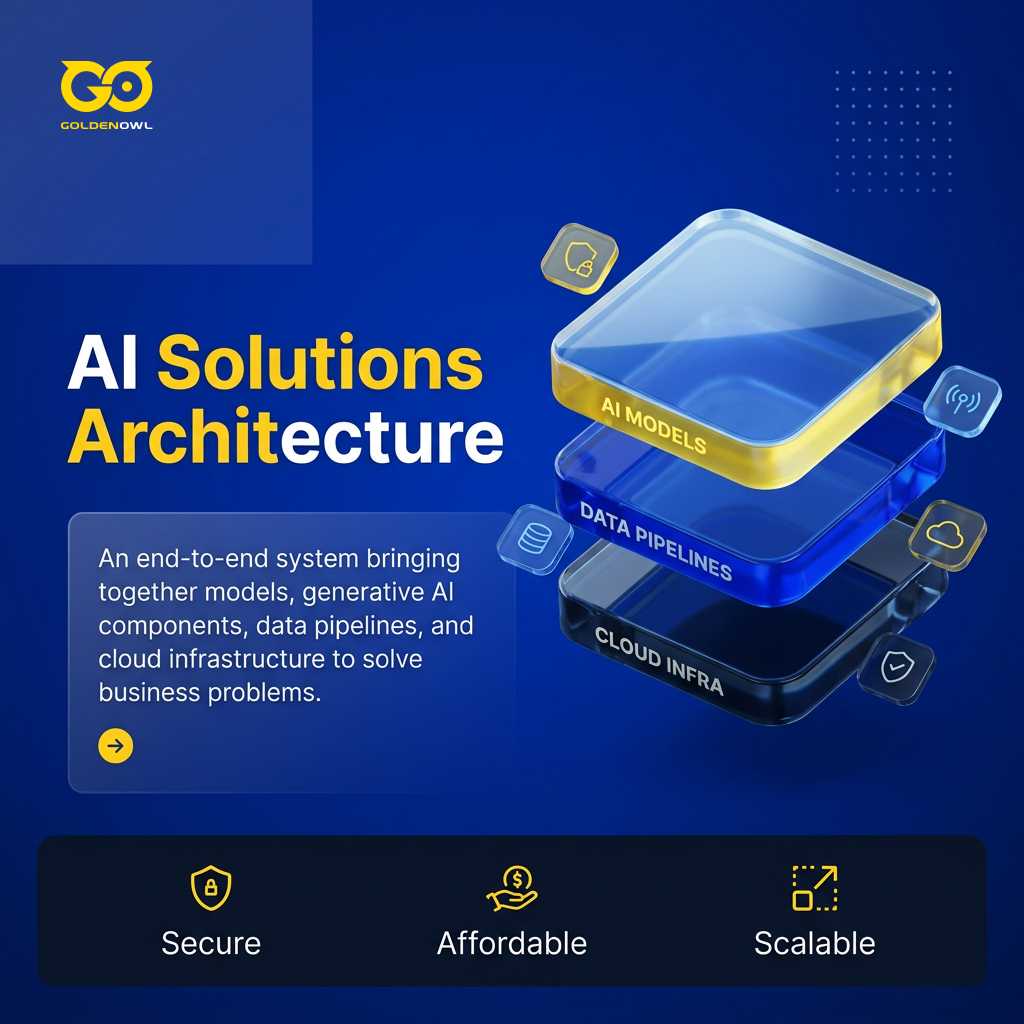
An AI architecture lead handles a system's design through deployment and growth, rather than writing model-training code line by line. The system brings together four parts: machine learning models, generative AI components, data pipelines, and cloud infrastructure. All four must solve a business problem securely, affordably, and at scale.
Engineers make the components; architects shape the system where those components run.
What Is an AI Solutions Architect and Why Enterprises Need One
Across the frameworks and deployment setups a company uses, an AI Solutions Architect sets the architecture direction and carries it through. Before you bring someone in, map the teams and systems this position has to tie together.
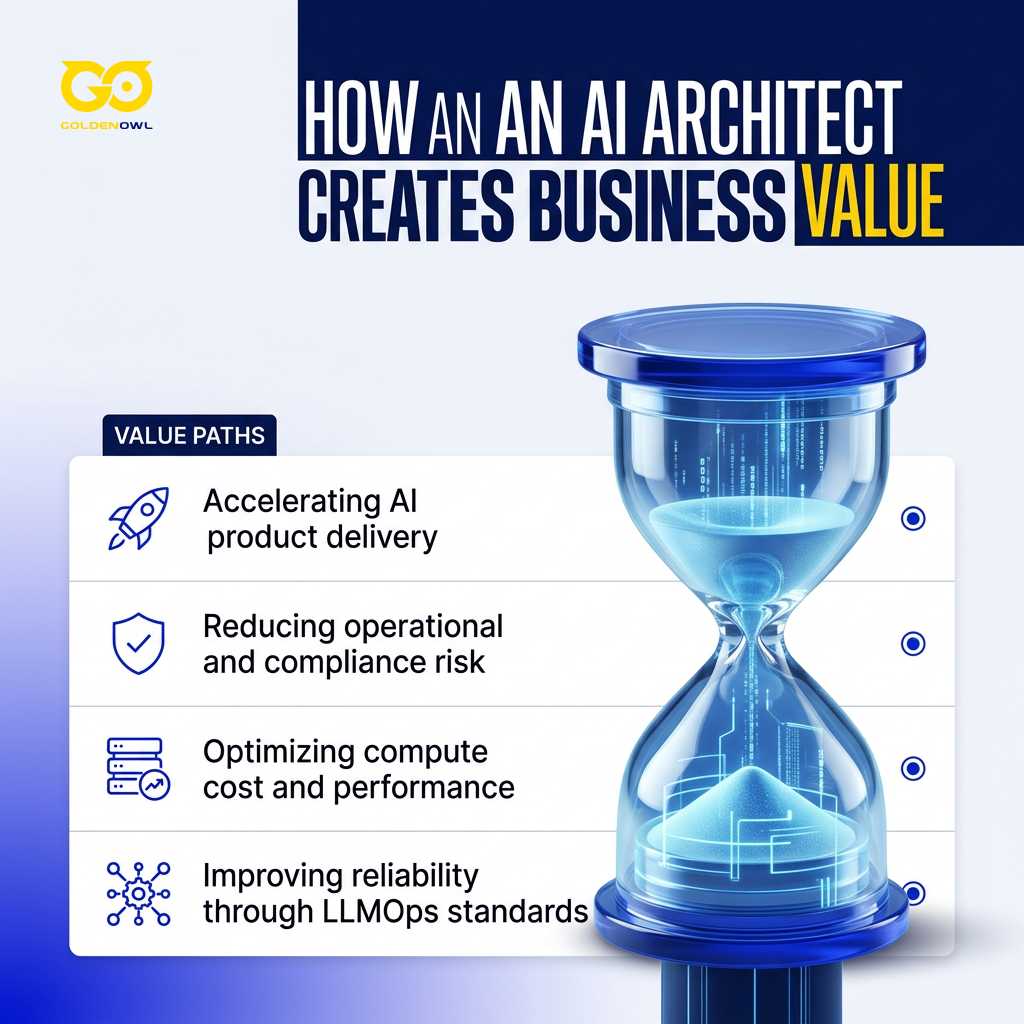
An AI Architect creates business value through four connected paths:
Accelerating AI product delivery through reusable patterns, reference architectures, and platform choices
Reducing operational and compliance risk through AI governance, security architecture, and control design
Optimizing cost and performance across training, inference, data movement, and compute
Improving reliability through MLOps/LLMOps standards, observability, and production readiness
Predictive ML, GenAI, decisioning, personalization, and automation all touch data pipelines, model lifecycle, application integration, governance, and operational resilience. Software companies and IT organizations need specialized AI architecture to keep those pieces connected.
Before you assess an AI Architect, map its links to existing systems, new programs, applications, and emerging trends.
Without that connection, organizations pile up fragmented experiments, ungoverned model deployments, and platform sprawl that can’t last. The result is platform sprawl.
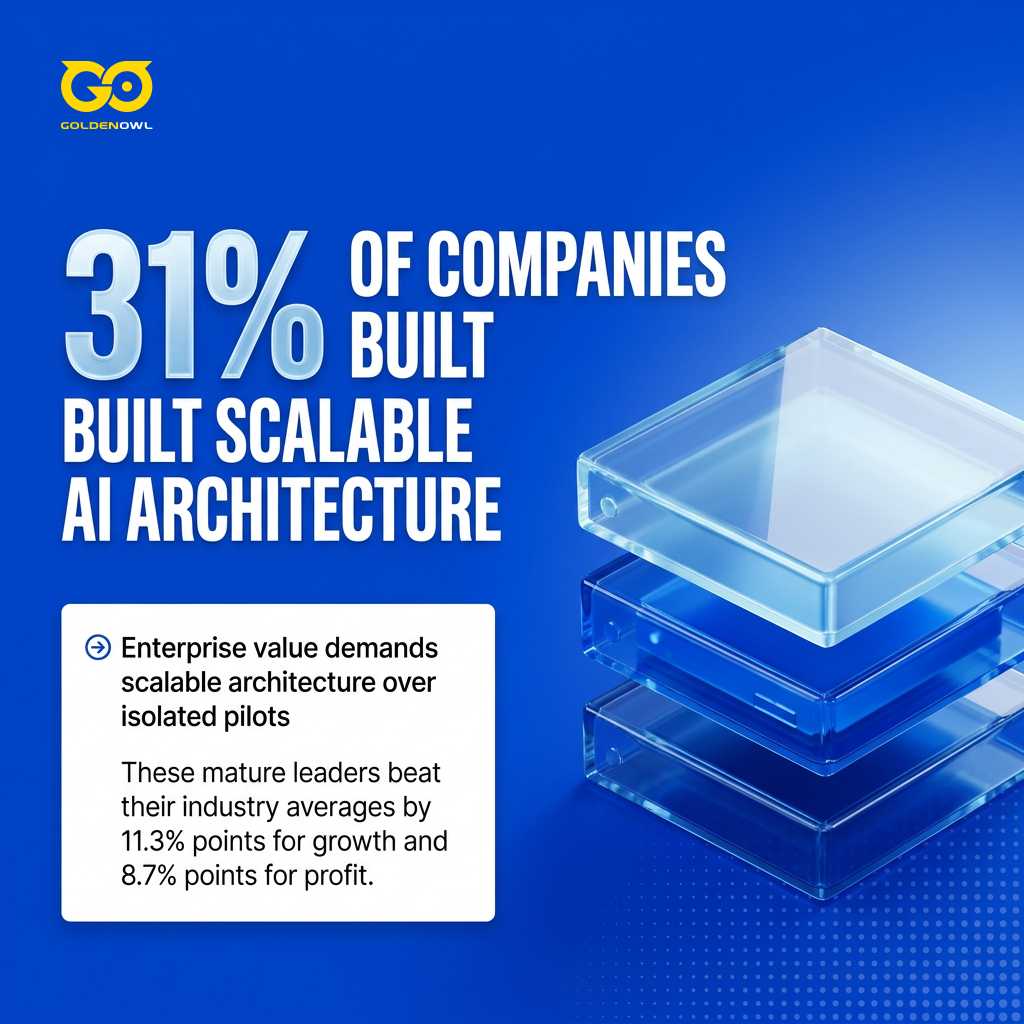
AI Architects shape, standardize, and keep improving enterprise AI architecture across data, models, applications, and infrastructure. Their work supports AI solutions that are ready for production, governed, cost-effective, and tied to business outcomes. In an MIT CISR survey covering 721 companies, the 31% in Stage 3 beat their industry average by 11.3 percentage points for growth and 8.7 percentage points for profit.
They built AI ways of working with scalable enterprise architecture, reusable model platforms, and designs made for reuse. Meanwhile, the 34% in Stage 2, still building pilots and capabilities, fell behind their industry average by 3.5 percentage points in growth and 2.2 percentage points in profit. The findings put architecture at the center of moving from isolated experiments to enterprise value, rather than treating it as an implementation detail.
Core Responsibilities of an AI Solution Architect
End-to-end AI architecture for dependable, secure systems that can scale, whether customer-facing products or internal platforms, sits with the AI Architect. You turn company aims into solution plans, then make calls across models, data, applications, and infrastructure while honoring security, privacy, cost, and reliability limits.
Taken together, these duties help you steer AI spending and carry the plan through delivery.
Enterprise Strategy and System Design
Enterprise strategy establishes the destination architecture and team-approved technology options while setting boundaries for future system growth.
Architectural Strategy
Primary System Trade-Off
Governance and Infrastructure Burden
Define the target-state AI architecture and roadmap aligned to business strategy, platform strategy, and product priorities
Establish enterprise AI reference architectures for predictive ML, GenAI/RAG, agentic workflows, personalization, and anomaly detection that teams can adopt with minimal friction
Set approved patterns, “paved roads,” minimum controls, and exception handling to balance speed with safety
Drive AI platform strategy across model hosting, feature stores, vector databases, orchestration, and observability
Assess build vs buy choices across these platform components
Building in-house infrastructure provides full control over latency and private data residency, while managed third-party services minimize initial overhead but can create continuous engineering maintenance, sudden pricing shifts, and vendor lock-in
Evaluate foundational model approaches using clear decision criteria
Choose between open-weight vs proprietary APIs, fine-tuning vs RAG, and on-device vs cloud inference
Own the technical blueprint for whether to use a pretrained foundation model or a custom-trained one, how retrieval-augmented generation (RAG) pipelines are structured, and how the system evolves as the business scales
They keep everyone moving in one direction without boxing out particular system or business needs.
Cloud and MLOps Integration
Because AI systems sit on cloud services and existing data warehouses, with CI/CD pipelines in the mix, architects plan retraining, redeployment, elastic scaling, cost control, and steady MLOps practices. Production remains available during releases.
Here’s what cloud and MLOps integration covers:
Use AWS, Azure, or GCP with existing data warehouses and CI/CD pipelines, and demonstrate how Amazon API Gateway, AWS Lambda, Amazon Elastic Container Service (Amazon ECS), and Amazon Elastic Kubernetes Service (Amazon EKS) support scalable, serverless architectures that incorporate AI functionalities.
Use model gateways to provide standardized access interfaces, separate applications from specific upstream providers, and simplify token routing.
Establish MLOps/LLMOps standards for model registry conventions, prompt versioning standards, and release gates, then design pipelines for CI/CD for models and prompts, model registry practices, automated evaluation, canarying, and rollback.
Design autoscaling configurations for variable AI workload demand, including AWS Auto Scaling, Amazon EC2 Spot Instances, and Amazon Sagemaker Inference to optimize performance and cost.
Build high-availability and disaster recovery designs through multi-AZ and multi-Region architectures, replication strategies, backup and restore procedures, and failover mechanisms that withstand failures and maintain continual operation.
Put together, these practices connect model operations to enterprise performance and cost needs, including recovery needs.
Cross-Functional Leadership
Across engineering, data science, product, and business leadership, the architect explains technical trade-offs to executives and turns business requirements into engineering direction.
Business requirements
Turn business needs into AI capability requirements, including NFRs that cover latency, privacy, explainability, and auditability.
Product and UX alignment
Partner with Product and UX on human-in-the-loop workflows and failure modes, with user-experience guardrails for AI-driven interactions.
Vendor evaluation
Help with procurement and vendor reviews through technical due diligence and architecture-fit assessments, plus risk reviews. For an agency delivery model, consider partnering with an external ai solutions company.
Technical leadership
Coach and guide ML engineers alongside data science and software engineering peers on production architecture patterns and standards.
Shared architecture practice
Create a community of practice with guilds, office hours, templates, and playbooks, scaling expertise without turning the architect into a bottleneck.
Governance, Security, and Compliance
Because AI workloads handle models and their data, solutions architects use security frameworks for these broader governance and protection duties. They encrypt stored data and data as it moves between systems.
This governance, security, and compliance work includes:
Managing model access with fine-grained AWS Identity and Access Management (IAM) policies, encrypting data at rest and in transit, and supporting compliance with relevant regulations.
Building governance in from day one through access controls, model explainability, bias monitoring, and compliance with data protection regulations such as India's DPDP Act or the EU AI Act where applicable.
Ensuring compliance-by-design where relevant, including privacy obligations, industry controls, SOC2/ISO-aligned practices, and regulated model risk management.
Defining dataset lineage, model lineage, and reproducibility standards so audits and incident response are supported.
Creating and maintaining secure-by-design patterns for prompts, tool use, and agentic workflows through input validation, tool permissions, and sandboxing.
GenAI-specific risks require explicit controls:
Prompt injection defenses through input handling and tool isolation
Data exfiltration controls through least privilege tool access and output filtering
Logging redaction and minimization
Role Distinctions Across the AI Hierarchy
Because controls sit across different layers of an AI system, the people handling them do different jobs. These jobs often overlap, but AI architects handle the AI systems and infrastructure around them, while AI developers take business needs from ideas to released applications and programs, including building and testing.
A recent analysis found poor data management among the reasons that roughly 50 percent of generative AI (genAI) implementations failed.
The AI Solutions Architect makes the calls that span the whole system, from the solution's operating environment and CRM connection to who can access data. They also determine how the solution can grow to serve 10 million customers while remaining compliant with data protection regulations.
AI Developer
Application delivery: AI developers turn business needs into applications and programs, moving from ideas through development, including testing, to deployment.
AI Engineer
AI solution development: AI engineers create AI-based solutions for defined needs and problems. Using algorithms plus machine learning alongside data and coding skills, they build and develop models for testing, successful application deployment, CRM connection, and user-specific data access control, and decide where a solution is hosted.
Machine Learning Engineer
Production model delivery: Machine Learning Engineers make models ready for production, from training pipelines and versioning through deployment.
Many AI Solutions Architects come up through AI engineering or related ML and data engineering.
Data Scientist
Data scientists analyze data and build models to answer specific questions.
Data scientists develop models and prompts, then evaluate them, while they rely on production architecture and platform support to run that work in production.
A data scientist may, for example, build a customer-churn prediction model that reaches 92% accuracy.
Governance and Decision Authority
Clear decision authority changes with organizational maturity, and an enterprise-grade blueprint generally marks the calls an architect handles alone and those that require escalation.
Independent Decision Guardrails
Within approved platforms and standards, architects can make these calls on their own:
Selecting architecture patterns for a given solution when they fit approved platforms and standards
Defining NFRs and production readiness criteria for AI services
Designing evaluation approaches and monitoring requirements with owning teams
Recommending prompt/model versioning strategies and deployment patterns
Approving minor architectural changes that do not affect security posture, cost envelope, or vendor strategy
Those guardrails keep teams moving without reopening choices that create broader organizational risk.
Executive and Compliance Escalations
Executive, compliance, or other organizational groups typically must weigh in on these decisions, such as GPU reservations and provider contracts at large scale:
Selecting vendors for major AI platforms or multi-year commitments
Reviewing high-risk use cases, such as decisions affecting regulated processes or sensitive PII at scale
Approving significant cost commitments, including GPU reservations and large-scale provider contracts
Making major target-architecture shifts, such as a multi-cloud AI strategy or enterprise model gateway rollout
Accepting residual risk when mitigations are incomplete
Budget:
For budgets, the architect usually shapes decisions alongside FinOps/Engineering leadership rather than owning them; leadership retains ownership.
Vendor:
For vendors, the architect handles technical due diligence and judges architecture fit, while procurement handles contracting.
Compliance:
Compliance leaves the architect designing the control architecture; the compliance organization interprets policy and owns the audit interface.
Day-to-Day Operations and Deliverables
The AI Architect works across several squads alongside engineering and data teams, connecting shared architecture rules and platform support with delivery inside each team. During design-review sessions and office hours, they field questions, clear blockers, and gauge data availability, model choice, RAG quality, integration, latency targets, and readiness for production. They track access to data, security, cost, vendor, and delivery exposure, then use error rates, quality, token usage, and drift when making calls.
They turn those calls into reusable paved-road templates, CI/CD workflows, evaluation suites, and release gates. The supporting record includes target-state and reference architectures, decision records, plus threat and data-flow documentation. Roadmaps and controls shift as adoption, incidents, cost trends, and tooling shift. When an AI endpoint goes down, the architect limits the impact with a rollback or provider fallback, coordinates escalation with security and incident teams, and makes sure root-cause analysis produces lasting architectural remediation rather than a patch.
Skills Every AI Solutions Architect Needs
AI solutions architects turn company goals into AI systems people can rely on from end to end. You use cloud and distributed-systems design to scale data, models, applications, and infrastructure while weighing function, quality, safety, latency, cost, and delivery limits. Data architecture also has to handle pipelines, access patterns, quality checks, lineage, governance, security, and privacy, with privacy allowing compliant model use.
Build practical programming and data-engineering experience, usually with Python, to run MLOps, deployment, monitoring, and the tools behind AI systems. Secure design, data governance, operational monitoring, and integration design must stay connected across the full system lifecycle.
Technical skill alone won't carry the architecture across an entire system. Systems thinking helps you spot trade-offs, integration holes, drift, and feedback loops before they turn into operational trouble. Clear designs, decisions, and risk summaries help product, security, privacy, legal, and engineering teams understand those trade-offs and act on them. Through Influence without authority, teams can take up the architecture you provide.
Required skills shift with the scale, risk, and roadmap you face. For Generative and agentic AI, map safe tool permissions, sandboxing, approval workflows, and memory management. For demanding workloads, design inference optimisation around quantization, distillation, batching, and low-latency serving. Regulated uses call for model risk management, while enterprise platforms require multi-tenant governance, isolation, quotas, and policy enforcement. Coaching and learning agility help teams take on changing practices.
Growing specialisms include model gateways and policy-as-code for central controls. Enterprise evaluation and benchmarking back regression testing and quality standards, along with multimodal architecture and on-device or edge inference when privacy or latency calls for it.
Hiring and Candidate Evaluation Framework
Production architecture is what hiring should reveal, beyond someone who can merely build model components.
Typical years of experience
Candidates commonly bring 8-12+ years from software, platform, data/ML, or architecture positions. Look for 3-5+ years directly running ML/AI systems in production, while allowing newer GenAI experience when the underlying fundamentals are strong.
Certifications may help, though they cannot stand in for experience.
Prior role backgrounds commonly seen
People arrive through several routes. Common backgrounds include Senior/Lead Software Engineer with AI platform exposure; ML Engineer / Applied Scientist with strong production and infrastructure experience; Data Engineer moving into ML platform and architecture; Cloud/Platform Architect extending into AI patterns; and Solution Architect for data platforms adopting GenAI architecture.
Leadership experience expectations
This is usually a senior individual-contributor leadership position. Candidates should demonstrate cross-team influence, mentoring, setting standards, and leading architecture reviews and decision forums. Managing people directly is optional, but mature leadership behavior is not.
Interview Assessment Dimensions
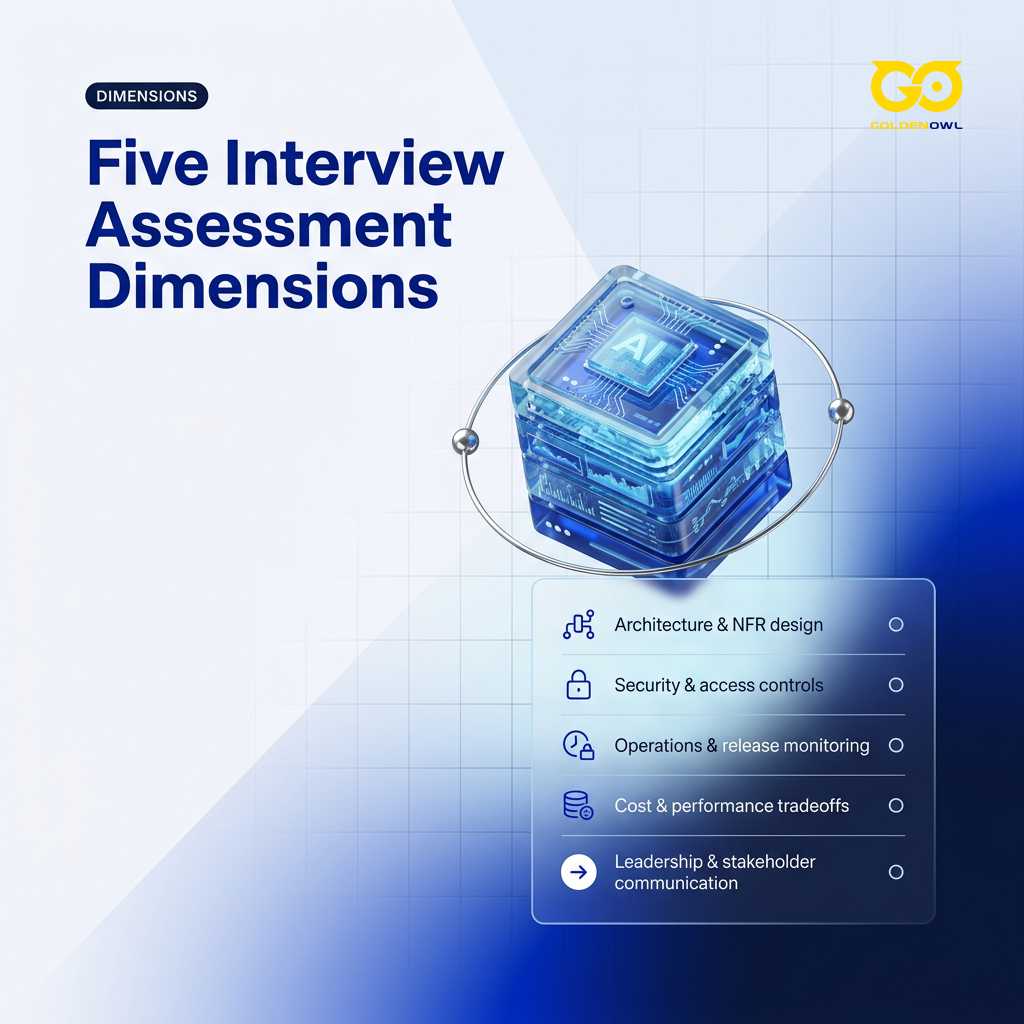
Give candidates a production-level AI system to design, then use identical evidence-based debrief prompts in every interview.
Architecture: Did they define data flows, interfaces, non-functional requirements, and failure modes?
Security: Did they cover access control, sensitive data, logging, and tool permissions?
Operations: Did they include monitoring, rollback, runbooks, and ownership?
Cost: Did they explain model, caching, scaling, or provider trade-offs?
Leadership: Could they explain the decision clearly to executives and engineers?
Write down interview examples instead of leaning on a general impression.
Where relevant, gauge GenAI depth through RAG, retrieval tuning, tool use, safety controls, and evaluation. Check MLOps/LLMOps maturity through release engineering, registries, monitoring, rollback, and governance integration.
Ask how they reason about threat models, data handling, least privilege, and logging controls. They also need to cover unit economics, caching, model selection, and the performance tradeoffs those choices create.
Their communication should show that they can write and present architecture, shift from executive summaries to engineering detail, and drive cross-team adoption with pragmatic standards.
Practical Case Studies and Exercises
Practical exercises reveal how people decide when production conditions shift around them.
Architecture case study (90 minutes): GenAI assistant for enterprise knowledge. Ask the candidate to choose foundational model approaches, including open-weight versus proprietary APIs, fine-tuning versus RAG, and on-device versus cloud inference, using clear decision criteria. Give them multiple data sources, including Confluence, tickets, and PDFs, along with privacy constraints, latency targets, and multi-tenant concerns. Require a high-level architecture diagram, retrieval and ingestion strategy, offline and online evaluation plan, security and privacy controls for redaction, access control and logging policy, plus a rollout strategy and failure modes.
Trade-off memo (take-home or live): Build vs buy for vector search / model gateway. Require the candidate to assess at least 3 options and recommend a path with its risks and mitigations.
Incident scenario drill: Provider outage and unsafe output spike. Ask the candidate for mitigations, fallback designs, monitoring, and governance improvements.
Taken together, these exercises show whether someone links system design with production operating and governance decisions.
Candidate Signals and Red Flags
Look for proof that teams can build and operate the architecture decisions they make.
Strong candidate signals
Good signs include clear architectures teams can implement, explicit NFRs, and realistic constraints. Strong candidates bring a production mindset to monitoring, rollback, runbooks, and reliability patterns. They measure GenAI quality and safety beyond anecdotal demos, and treat governance as useful work.
They document choices with ADRs and decision matrices, state tradeoffs plainly, and use templates, paved roads, and enablement to spread patterns across teams.
Weak candidate signals
Model selection by itself tells you little. Watch for people who skip data, integration, or operations, force patterns such as RAG into every situation without fit-to-purpose analysis, or call GenAI quality subjective while avoiding evaluation discipline.
Other warning signs include missing the security and privacy impact of prompts, logs, and tool use; building overly complex platforms too early; overlooking platform needs; or being unable to explain cost and reliability effects. Watch for “ivory tower” outputs that teams do not adopt. Those gaps emerge in operating work.
Red flags
Treat unredacted, retained sensitive prompts or responses in storage or logs as serious red flags, along with broad agentic-system permissions that lack containment.
Be careful when confidence leaves no space for uncertainty, risk, or tradeoffs. A “One vendor solves everything” view may overlook lock-in, outages, and data constraints.
Treat architecture that teams won't adopt as a red flag. Interviewers also misread AI architects when they test raw mathematical theory rather than enterprise data isolation, provider outages, and cloud billing surprises.
Milestone Roadmap and Success Metrics
Use a framework that tracks the work delivered as output, the outcome and its effect, quality against standards, plus operational stability and cost. Adjust the sample benchmarks to match the work’s maturity.
An AI Architect succeeds when AI solutions move into production reliably, with clear safety and quality guarantees. Decisions remain transparent and repeatable as reuse increases and AI cost and risk stay under control.
Onboarding and Early Milestones
Begin the assignment by defining three concrete outputs.
Current-state map: inventory AI use cases, data paths, vendors, and production risks.
Minimum guardrails: define approved patterns for access, logging, evaluation, rollback, and monitoring.
Prioritized roadmap: identify the highest-risk initiatives, quick wins, platform dependencies, and decisions requiring leadership input.
These outputs let leaders see what’s happening while the architect learns the environment before shaping the full platform.
During the first weeks, have the AI Architect map company priorities and current AI use cases, both customer-facing and internal. Include models, providers, data sources, pipelines, endpoints, governance posture, and gaps in that map.
Build relationships across architecture, security, data, platform, and product while the architect identifies the 3-5 highest-risk AI initiatives, whether production or near-production.
This should produce a current-state architecture and a ranked set of quick wins. Set minimum viable standards for RAG and inference, baseline logging and monitoring, and security and privacy guardrails.
Before teams build more, ask the architect to define production-readiness gates for evaluation, rollback, monitoring, and documentation. Agree on approved tools and platform components, including approaches for a model gateway and vector store.
Give at least one initiative architecture-review support through its production launch, with measurable improvements in cost, latency, safety, or quality. The architect should then produce the AI target architecture alongside a 6-12 month platform roadmap.
Delivery teams can establish a regular architecture-review rhythm and a lightweight ADR practice. Their evaluation framework should include an offline harness for key tasks and an online monitoring plan with quality metrics.
The operating model should explain when architects get involved, how exceptions are handled, and where governance enters the process. Over time, teams will see shorter cycle times, less rework, and clearer decision paths.
Long-Term Platform Maturity
Long-term maturity shows whether early standards turn into repeatable platform capabilities instead of isolated efforts.
6-month milestones
By 6 months, teams should have a paved road for at least one core AI pattern, such as a RAG service template, vector ingestion pipeline, and evaluation harness. They should also have fewer AI production incidents or a stronger recovery posture, backed by clear runbooks and tested failover.
Tool sprawl should start narrowing through a standardized vector store or a defined supported set. A standard model gateway / provider abstraction, Token/GPU budget alerts, caching patterns, and model-selection guidance should make cost controls visible.
Governance instrumentation should show model inventory coverage above an agreed threshold, with approvals and monitoring already in place.
12-month objectives
At 12 months, the enterprise AI platform should have standardized model serving and deployment pipelines, CI/CD evaluation automation, and centralized observability for AI quality, safety, and cost.
Teams should settle on reference architectures for common AI patterns. The time required to put AI features into production should fall by a meaningful percentage, often 20-40%, depending on context.
Where it applies, governance should be audit-ready through repeatable evidence generation and control automation, while portability patterns lower vendor lock-in risk where economically justified.
Long-term impact goals (18-36 months)
Within 18-36 months, the organization should support a multi-product AI capability ecosystem with shared knowledge ingestion, policy enforcement, and evaluation.
AI should become a dependable product capability, with predictable delivery, measurable quality, and a low incident rate as teams default to secure, compliant, cost-aware patterns.
The organization should be ready for multimodal, agentic orchestration, and on-device inference without disrupting production.
Evaluation Metrics and KPIs
These metrics connect architecture adoption, delivery speed, production quality, reliability, cost, and governance to measurable benchmarks.
Metric Name
Measurement Type
Target Benchmark
Reference architecture adoption rate
Outcome
60-80% of new AI projects within 2 quarters
Time-to-architecture-signoff
Efficiency
≤ 10 business days for standard patterns
Production readiness compliance
Quality
≥ 90% compliance for production launches
AI incident rate
Reliability
Downward trend quarter-over-quarter
Mean time to mitigate (MTTM) for AI incidents
Reliability
Improve by 20-30% in 6-12 months
AI cost per 1k requests / per user action
Efficiency/Outcome
Defined per product; target within budget envelope
Cache hit rate (inference/RAG)
Efficiency
20-60% depending on use case
Model/prompt drift detection coverage
Quality
≥ 80% of Tier-1 systems
Model inventory completeness
Governance
≥ 95% for production
Tune these benchmarks to the organization’s maturity, product context, and budget envelope while keeping delivery, risk, and operational performance in view.
Operational Challenges and Anti-Patterns
Clear success criteria set the bar for production: GenAI demos arrive fast, but systems last only when grounding, disciplined evaluation, monitoring, and prompt/model rollback are built in. Include redacted sensitive-data logs, retention controls, and least-privilege agent tools from the start. Weak data quality, access approvals, or lineage can hold up usable data; poor data management, among other factors, caused roughly 50 percent of genAI implementations to fail. Set up Self-service paved roads, platform engineering, enabling architecture review, and provider abstraction. Token consumption and GPU expenditures may surge, while infrastructure and budget limit ambition as standards shift, causing bottlenecks, slow decisions, lock-in, and outage fragility.
Frequently Asked Questions
What qualifications do I need to become an AI Solutions Architect?
Expect AI Solutions Architects to commonly arrive with 8-12+ years in software engineering, platform engineering, data/ML engineering, or architecture roles.
Typical years of experience
Plan on 8-12+ years across those fields before reaching architecture roles.
Education expectations
A Bachelor’s in Computer Science, Software Engineering, Data Science, or a related field is common, though equivalent hands-on experience is frequently accepted.
Certifications
Hands-on experience usually matters more than certifications, even if some organizations treat them as useful signals. AWS provides two certifications: AWS Certified Solutions Architect, Associate and AWS Certified Solutions Architect, Professional.
Is AI Solutions Architect a good career in 2026?
Yes, this path can bring solid pay and exceptionally strong growth potential as enterprises shift AI pilots into production-scale systems. Regional factors influence ai solution architect salary ranges.
Over the ten years ending in 2034, the US Bureau of Labor Statistics (BLS) projects healthy expansion in computer and information technology professions, with database architect jobs growing 4 percent and computer and information research scientist jobs growing 20 percent.
This combination of skills is scarce, putting AI Solutions Architect positions at a real premium beside adjacent engineering jobs.
What is the difference between an AI Architect and an AI Solutions Architect?
Across the industry, AI Architect and AI Solutions Architect are largely interchangeable titles. Where companies draw a line, an AI Architect may spend more time on models and system design, while an AI Solutions Architect often ties that design to business solutions and cloud deployment.
A Data Scientist uses data to build models around specific questions. A Machine Learning Engineer gets those models ready for production through training-pipeline work that includes versioning and deployment.
How long does it take to become an AI Solutions Architect?
Typically, reaching systems-level expertise takes 5-8 years after beginning in engineering or data work and advancing through ML/AI engineering leading up to architecture roles; Structured certification programs can cut that learning curve considerably.
Build a strong technical foundation.
Gain hands-on AI/ML engineering experience.
Learn cloud and system architecture.
Specialize through certifications and advanced programs.
Move into architect-level roles.
Do I need a master's degree to become an AI Solutions Architect?
No, a Master’s degree is optional for an architecture-focused role.
Research-heavy settings more commonly favor a Master’s or PhD. Many people reach architect-level positions through proven project experience, certifications supporting a strong portfolio of production AI systems, rather than academic credentials alone.
Candidates and hiring teams can judge the role through a clearer filter: years spent in engineering and architecture, along with production AI systems linked to cloud deployment and business solutions. Titles differ, while degrees and certifications can still act as signals; that path also clarifies what is an AI solutions architect in practice. The path commonly starts in engineering or data work and builds systems-level expertise in ML/AI engineering, with BLS projections supplying the wider view through 2034.
Share this page
Table of Content
Subscribe to Golden Owl blog
Stay up to date! Get all the latest posts delivered straight to your inbox
The best AI solution for virtual receptionist call summaries automatically creates structured records from each conversation, giving teams a clear account of every interaction without manual notes or asking employees to replay recordings.